
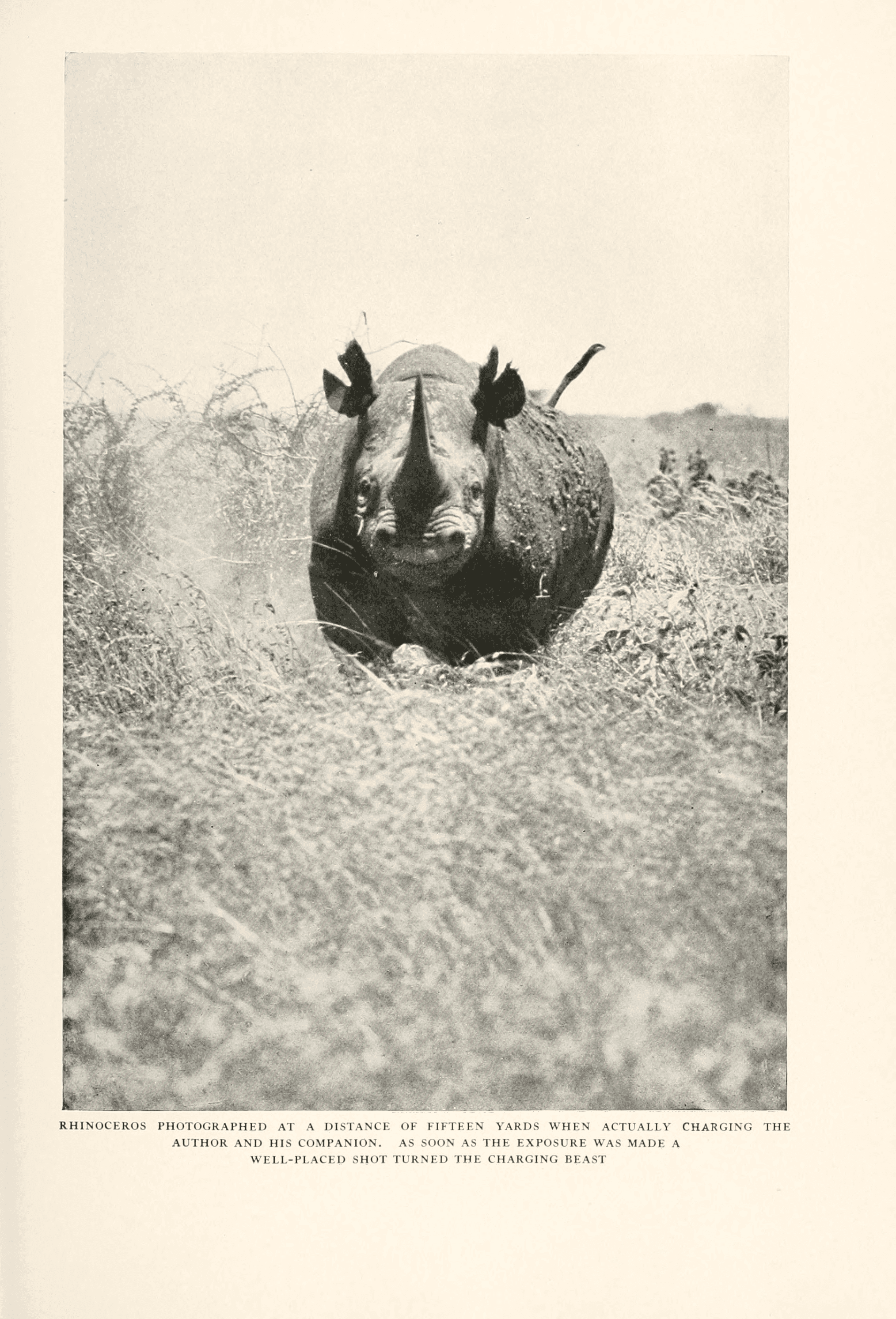
Fifteen yards is not far when a black rhinoceros is coming at you.
In 1908 Arthur Radclyffe Dugmore travelled through British East Africa with a cumbersome camera, photographic plates, tripods, a caravan of porters — and a rifleman. His purpose was unusual enough to become the subtitle of the book he published two years later: to secure photographs of African game "from life."
One of those photographs shows a black rhino charging almost straight at the camera. The surviving caption records that it was photographed at a distance of fifteen yards. Dugmore later explained the arrangement with his companion. He would make the exposure; the sound of the shutter was the signal for the rifleman to fire.
Click. Bang.
It is a disturbing image when viewed through a modern conservation lens. But it is also a remarkable historical moment. The camera was beginning to challenge the rifle as the means by which a visitor to Africa could take home a trophy. Yet the two had not separated. The rifle still stood beside the camera, and sometimes the photograph depended upon it.
Dugmore called photography the "bloodless form of sport." More than a century later, those words deserve another look — because while he was experimenting with a new way of seeing Africa’s wildlife, the black rhinoceros was already disappearing on a scale that is almost impossible to comprehend.
A slaughter already under way
It is tempting to imagine Dugmore photographing a pristine East Africa before the great destruction began. The historical record tells us otherwise.
Nigel Leader-Williams' analysis of the loss of Africa's rhinos reconstructed the extraordinary scale of the nineteenth-century East African horn trade. From approximately 1849 to 1895, exports averaged around 11,000 kilograms of rhino horn a year. Converting that quantity of horn into animals produces an estimate of roughly 170,000 black rhinos killed over those 47 years.
That number must be understood correctly. It is not a register of 170,000 individually documented carcasses. It is a historical reconstruction based on traded horn weights and assumptions about the amount of horn represented by an average animal. But even allowing for the uncertainties inherent in nineteenth-century trade records, the magnitude is staggering.
Approximately 3,600 rhinos a year. Nearly ten every day, sustained across almost half a century.
Dugmore therefore arrived in British East Africa not at the beginning of the slaughter but after decades of it.
The black rhino was still sufficiently abundant to create the illusion of inexhaustibility. That illusion would prove fatal to wildlife across Africa. When an animal occurs in large numbers, each individual death can appear insignificant. A horn becomes a commodity. A skin becomes a trophy. A carcass becomes an entry in a ledger. Only when the accumulation of those individual deaths becomes a population collapse does society finally understand what has been lost.
The trophy that did not need porters
Two pages near the end of Dugmore's 1910 book reveal the contradiction better than any modern interpretation could.
On page 198 he lists the personnel required for safari: a headman, cook, tent boy, askaris, around thirty porters — and a gunbearer. Photography had entered the safari, but the gun had certainly not left it.
On the following page Dugmore discusses another logistical problem: trophies. Heads and skins were heavy. A successful rifle hunter in a country with abundant game might accumulate so many trophies that additional porters were required simply to carry the dead animals' remains out of the interior.
Then comes his remarkable observation. When the camera replaces the rifle, he writes, the results of the chase are less cumbersome. He predicts that it may take years before sportsmen understand the fascination of this "bloodless form of sport."
Read today, it sounds obvious. In 1910 it was not.
The traditional safari trophy was physical possession of part of the animal: horn, tusk, skin, skull or mounted head. Dugmore was proposing that the memory, prestige and excitement of the hunt could be retained while the animal itself remained in Africa.
The photograph could become the trophy.
That philosophical change was enormous, even if the transition was messy.
When camera hunting was still hunting
Dugmore's most famous rhino photographs expose just how messy it was.
Historian James R. Ryan, examining the relationship between photography and empire, points out that Dugmore's attempts to secure dramatic pictures sometimes placed both photographer and animal in situations where the rifle became the final insurance policy. In Dugmore's account of the fifteen-yard charge, he waited until the rhino was as close as he considered prudent, released the shutter and his companion fired on hearing it.
The camera and rifle were almost operating as a single weapon.
Another contemporary account of a Dugmore rhino encounter is even more extraordinary. A sleeping rhino was approached at close range. When the animal charged, shots were fired with a shotgun and revolver and a Maasai man used a spear. Despite all of that, the animal apparently escaped.
This is why the historical record needs careful language. A rhino photographed charging was not necessarily killed. A rhino fired upon was not necessarily killed. Even a badly wounded rhino could disappear into the bush.
The evidence establishes that Dugmore's photographic method could result in animals being shot and that shooting was sometimes deliberately integrated into the plan for obtaining a close photograph. What it does not justify is casually assigning a death to every charging-rhino photograph.
That distinction matters. Conservation history is powerful enough without embellishment.
Thirteen rhinos
Perhaps the most haunting part of Dugmore's story came later.
During his first East African journey he could encounter black rhinos in numbers that seem almost unimaginable today. Accounts of his experience record an occasion when thirteen rhinos could be seen at once, while groups of four or five were not exceptional.
Yet Dugmore already sensed danger. He predicted that the rhinoceros would probably be among the first great African animals to disappear.
He returned to East Africa in 1921–22.
The comparison is brutal.
On the earlier journey, thirteen rhinos could be visible at one time. On the later journey, after travelling extensively through country and former rhino haunts, he recorded seeing only thirteen altogether.
Thirteen in one view.
Thirteen on an entire journey.
Population science is more complicated than comparing two anecdotes, and we should not pretend that these observations constituted a formal survey. But as an eyewitness account of changing abundance, the symmetry is extraordinary. Dugmore had watched the beginning of a transformation that would accelerate catastrophically during the rest of the century.
Nearly a century later, I had my own visual lesson in what rhino abundance can look like. I obtained my helicopter licence in 2005 and eventually logged around 1,500 hours, much of it flying a Robinson R44 in Southern Africa. Around 2006, on a flight from White River into the Sabi Sand, I saw a crash of roughly 15 to 18 rhinos below me. Within about five minutes' flying time I saw another crash of roughly the same size — somewhere around 30 to 36 rhinos within minutes. These would have been white rhinos, a far more social species than the black rhinos Dugmore was describing, so it is not a like-for-like comparison. But I know what that many rhinos look like in a landscape. It makes Dugmore's account of thirteen black rhinos visible at once all the more extraordinary.
From abundance to extermination
The twentieth century added new forms of destruction to the old ones.
Rhinos were not killed only for trophies or horn. They were also treated as obstacles to settlement, agriculture and livestock production. In the Makueni area of Machakos District, southeast of Nairobi, the British colonial Game Department undertook a wildlife-clearance programme. John Waithaka's historical account records that 996 rhinos were killed between 1944 and 1946 to open 200 square kilometres for settlement (Waithaka, 2012, p. 26).
J. A. (John Alexander) Hunter, the Scottish-born British professional hunter who carried out game-control work for the colonial administration, was involved in the operation. In his memoir he wrote that Kamba people had requested more land through the Machakos District Commissioner, and that Captain Ritchie had sent him to undertake the clearance. The demand for land was local; the authority to organize and carry out the killing belonged to the British colonial administration (Hunter, 1952, chapter 12).
One thousand rhinos.
To a modern conservationist, the figure is almost incomprehensible. At the time it could be presented as development.
Makueni exposes a wider contradiction in colonial wildlife policy. The administration created game reserves and restricted hunting, while also authorizing the destruction of animals where they obstructed settlement or farming. Across colonial Kenya, land appropriation, agricultural expansion and commercial hunting transformed habitats and wildlife populations. At Makueni, mass killing became an instrument of government development policy (Waithaka, 2012, pp. 25–26).
Hunter's own account makes the transformation tangible. Returning through country that had recently been dense thorn bush crossed by rhino trails, he found farming land, whitened bones and the blackened circles left by burned brush. He recorded 163 rhinos killed in the particular three-month clearance phase he described. That figure should not be confused with the wider programme's total of 996, or with his statement that he had shot more than a thousand rhinos by the time he wrote his memoir.
He also questioned whether destroying such animals to provide more land had been worthwhile. His answer was: "I do not know." It was an expression of doubt, rather than an apology. He continued to present the outcome as an inevitable conflict between people and wildlife. His unease nevertheless leaves a disturbing record of a man looking back at a landscape he had helped empty (Hunter, 1952, chapter 12).
Hunter was part of a much wider history of killing. Published accounts credit W. D. M. 'Karamojo' Bell, Jim Sutherland, John 'Pondoro' Taylor, Henry Hartley, Frederick Grant 'Deaf' Banks, Pete Pearson, 'Samaki' Salmon, Harry Manners, Ian Nyschens, Tony Sánchez-Ariño and Ron Thomson with elephant totals of around a thousand or more each. William Finaughty, Petrus Jacobs and G. H. 'Andy' Anderson are credited with several hundred apiece, also exceeding 300. Beyond Africa, in British-ruled Ceylon, now Sri Lanka, Thomas William Rogers, Thomas Skinner and Philip Payne-Gallwey were each reported to have killed more than 300 elephants, with contemporary accounts placing their totals substantially higher. Sánchez-Ariño was also reported to have killed 340 lions. These figures come from memoirs, contemporary testimony and later biographies, rather than a common audited record. They span commercial ivory hunting, sport and government control, across colonial and later periods. Together they show how repeated individual killing, sometimes undertaken as official work, could accumulate into extraordinary losses.
The international horn trade continued as well. Leader-Williams' historical figures show declared East African horn exports fluctuating through the twentieth century, but the killing never disappeared. In the 1970s, the estimated horn represented by exports again rose sharply.
The declared export figures give that trade a brutal scale. Between 1949 and 1976, Kenya, Uganda and Tanganyika/Tanzania officially recorded 56,694 kilograms — 56.7 tonnes — of rhino horn exports. Of that, 23,852 kg went to Hong Kong, 9,007 kg to Aden/South Yemen, 8,101 kg through Zanzibar and 7,619 kg to China; the United States, Britain and Japan also appear in the records. Using roughly 2.88 kg for the pair of horns of an East African black rhino, the declared trade alone represents the horn equivalent of about 19,700 rhinos. It is not a carcass-by-carcass count, and undeclared trade means it cannot be treated as the total killed. But it puts the scale into perspective: tens of thousands of rhinos reduced to kilograms in an export ledger.
The price moved in the opposite direction to the population. The same TRAFFIC table records an average export price of about US$6 per kilogram in 1949 and US$100 per kilogram by 1976. As the animal became scarcer, what grew on its face became increasingly valuable.
Then the population collapsed.
Africa was estimated to hold around 65,000 black rhinos in 1970. By 1992, only about 2,500 remained — a decline of more than 96 percent in little more than two decades.
Kenya's experience was particularly devastating. Its black rhino population was estimated at roughly 20,000 in 1970. By 1990 fewer than 400 remained.
This was no longer the gradual erosion Dugmore had witnessed. It was a biological free fall.
What was the horn for?
The killing was driven by several markets, and conservation messaging has not always described them accurately.
Rhino horn was used in parts of East and Southeast Asia in traditional medicines, particularly for fever and related conditions. The familiar Western story that rhino horn was primarily an aphrodisiac oversimplified — and often misrepresented — the major traditional medicinal demand.
A second important market developed around jambiya dagger handles in Yemen, where rhino horn became a prestigious material.
Different cultures, different uses, same result.
The living animal was converted into a transportable commodity whose value increased dramatically as it moved along the supply chain. The person who killed the rhino could receive a fraction of the final value. Middlemen, traffickers and retailers captured the rest.
This is a pattern I have written about before in the ivory and rhino-horn trades. The killing takes place in Africa, but the economics that make the killing worthwhile can originate thousands of kilometres away.
CITES and the limits of a ban
CITES entered into force in 1975. Black rhinos were subsequently placed under the Convention's highest level of international commercial trade restriction.
That was essential. It was also not enough.
A law written in Geneva does not patrol a national park in Kenya, Tanzania, Zambia or Zimbabwe. It does not pay a ranger. It does not repair a vehicle, gather intelligence, prosecute a trafficker or persuade a consumer not to buy horn.
Leader-Williams' work made this point with uncomfortable clarity: rhino survival depended not merely on international legal status but on effective protection, adequate conservation expenditure and the economics facing the person deciding whether to poach.
If the potential reward is high, legitimate opportunities are poor and the probability of detection and punishment is low, the rhino carries the risk.
That remains one of the great lessons of wildlife trade policy. A ban can close a legal door. It cannot by itself remove demand, corruption or criminal opportunity.
The value of the living animal
And this is where Dugmore's camera becomes more than an interesting historical curiosity.
Photography helped change the value proposition.
The old trophy was consumed once. A rhino was killed, its horn removed, its head mounted, its skin preserved. Whatever value society assigned to that animal was realised through its death.
A living rhino can generate value repeatedly.
It can be photographed this morning and again tomorrow. It can be seen by generations of visitors. It can produce calves. It can become part of scientific research, conservation education and a tourism economy that pays guides, trackers, lodge staff, pilots, rangers and neighbouring communities.
For those of us who have spent years photographing Africa's wildlife, the contrast is profound.
With a modern digital camera and a long telephoto lens I can photograph a black rhino from a respectful distance and produce an image containing detail Dugmore could scarcely have imagined. I can make multiple frames in a second, examine the eye, the folds of skin and the texture of the horn — and then lower the camera and leave the animal standing exactly where I found it.
There is no need for the shutter to be a signal for somebody beside me to fire a rifle.
That technological difference is important. The philosophical difference is greater.
Photography did not save the rhino — but it changed the conversation
We should resist an attractive but simplistic conclusion that wildlife photography somehow saved the black rhinoceros.
It did not.
Rhinos survived because of extraordinarily committed conservationists, rangers, governments, private and community landholders, scientists, donors, veterinarians and anti-poaching teams. They survived because remaining populations were moved, guarded, monitored and intensively managed. They survived because people were sometimes prepared to risk their own lives to keep them alive.
But photography changed how millions of people who would never visit Africa could encounter these animals.
A mounted head tells us that an animal was conquered.
A photograph can show us an animal living.
That distinction matters.
Dugmore's 140 photographs presented wildlife not simply as a collection of specimens but as living animals occupying landscapes and behaving in ways readers could witness. Later generations of photographers, filmmakers and naturalists expanded that idea until the wildlife documentary and photographic safari became part of the global language of conservation.
The image could create attachment without requiring possession of the animal itself.
The uncomfortable pioneer
Dugmore therefore deserves neither canonisation nor condemnation.
He was a man of his period standing at a historical crossroads.
He carried a camera because he believed there was a better way to experience wildlife than simply killing it. He also carried rifles, travelled with a gunbearer and participated in close encounters in which animals could be shot to secure the photographer's safety after the photograph was made.
Those facts do not cancel one another. Together they make the story important.
The transition from hunter to camera hunter did not happen in a clean moral instant. The language of stalking, shooting, bagging and trophies migrated directly from hunting into photography. Even today photographers speak of "shooting" an animal.
What changed was the consequence of pulling the trigger.
The rifle captured the animal by ending its life.
The camera captured an instant and allowed the animal's life to continue.
A century later
My connection with rhinos has also extended beyond photography. I have served on the board of The Rhino Orphanage for about thirteen years and now chair it, while supporting fundraising for work that has included rhino translocation, dehorning, tagging and related conservation efforts. That experience inevitably colours how I read Dugmore today — but this story is primarily about photography, and about the extraordinary change in what a camera allowed us to bring home from Africa.
I have spent years involved in rhino conservation and have seen the consequences of the modern horn trade at painfully close range. A poached rhino carcass is not an economic theory. It is a huge animal reduced to a crime scene because somebody, somewhere, placed a price on the growth on its face.
That is why the historical numbers matter.
Roughly 170,000 black rhinos represented by the nineteenth-century East African horn trade.
Around 65,000 black rhinos remaining across Africa in 1970.
Around 2,500 by 1992.
Behind every statistic was an animal.
And behind the statistics was a recurring human mistake: believing that abundance was infinite and that the extraction of one more horn, one more trophy, one more animal could not possibly matter.
Dugmore's great contribution was not that he invented conservation photography or that his own methods met the ethical standards we would expect today. They did not.
His contribution was that, at a time when killing was embedded in the culture of safari, he articulated another possibility.
The camera could replace the rifle.
The trophy did not have to bleed.
Closing
There is a photograph from Dugmore's expedition that freezes the contradiction in a fraction of a second: a black rhino charging, the photographer holding his ground, the rifleman ready.
The shutter falls.
The picture is made.
More than a century later, we can look at that photograph without needing the horn, the skin or the head of the animal that stood in front of the lens.
Perhaps that is the most important legacy of the transition Dugmore represented.
First we travelled to Africa and shot its wildlife so that we could carry pieces of it home.
Then we learned to shoot it with cameras.
Eventually, we began to understand that the greatest privilege was not bringing the animal home at all.
It was leaving it there.
Author's note on historical figures
The estimate of approximately 170,000 black rhinos killed between 1849 and 1895 is a reconstruction from historical East African rhino-horn trade volumes, not a carcass-by-carcass count. It should be presented as an estimate.
The often-cited African black rhino population estimates of approximately 65,000 in 1970 and approximately 2,500 by 1992 likewise reflect the best available conservation estimates rather than complete censuses.
Dugmore's surviving accounts clearly show that rifles were sometimes used during close photographic encounters. However, a photographed charge, a shot fired and a confirmed death are not automatically the same event. This draft deliberately avoids assigning a precise Dugmore kill tally where the available primary text does not establish one beyond reasonable doubt.
The Makueni programme total of 996 rhinos and the dates 1944–1946 follow Waithaka (2012, p. 26). They refer to the Game Department programme, not an independently verified personal kill tally for Hunter. His memoir's account of a three-month phase, and its separate reference to more than a thousand rhinos shot over his work, must be read as distinct claims.
Principal sources
Arthur Radclyffe Dugmore, Camera Adventures in the African Wilds (Doubleday, Page & Co., 1910), digitised by Google Books.
Nigel Leader-Williams, Causes of Loss of Africa's Rhinos (1993), Rhino Resource Center archive.
Nigel Leader-Williams, The World Trade in Rhino Horn: A Review (TRAFFIC International, 1992), especially Table 1 on declared East African exports, 1949–1976.
James R. Ryan, Picturing Empire: Photography and the Visualization of the British Empire (1997), discussion of Dugmore and early camera hunting.
Rhino Resource Center, Dugmore in Kenya photographic archive, including the charging-rhino and Yata Plains plates.
Kenya Wildlife Service, Conservation and Management Strategy for the Black Rhino in Kenya 2012–2016.
Dex Kotze, 'The Legal Racketeering of Ivory', Africa Geographic (2016), used as a stylistic reference for historical trade-to-animal numerical framing.
Dex Kotze, 'Tracking the Silent Giants of Africa', Africa Geographic (2017), used as a stylistic reference for first-person conservation reporting.
J. A. Hunter, Hunter (Harper & Brothers, 1952), chapter 12, 'The Great Makueni Rhino Hunt', pp. 166–190.
John Waithaka, 'Historical Factors that Shaped Wildlife Conservation in Kenya', The George Wright Forum 29, no. 1 (2012), pp. 21–29, especially pp. 25–26.
W. D. M. Bell, The Wanderings of an Elephant Hunter (Country Life, 1923); Tony Sánchez-Ariño, Elephant Hunters: Men of Legend (Safari Press, 2005). Comparative totals are reported claims and estimates, not independently audited tallies.